
At a glance:
- With interfaced external AI, deal teams are constrained by the limitations of the external tool’s API. And they are forced to adopt an entire external tool’s logic – you can’t choose just the features relevant to your deal.
- Embedded AI is interactive by design. The moment a request is made, it begins processing instantly within the secure environment. External AI integrations can’t match that responsiveness.
- For deal teams working under time-pressure, embedded AI is the only approach purpose-built to keep up with the pace of a live transaction.
Not all VDR AI is created equal
In our first blog, we explored how the way AI is implemented in your VDR, embedded or interfaced external, has significant implications for your deal security. But security isn’t the only consideration.
How your VDR’s AI is implemented also has a direct impact on how well it actually works in a live deal – its responsiveness, the granularity of its document intelligence, and how seamlessly it fits into your deal workflow.
So, what are the differences from a technical implementation point of view?
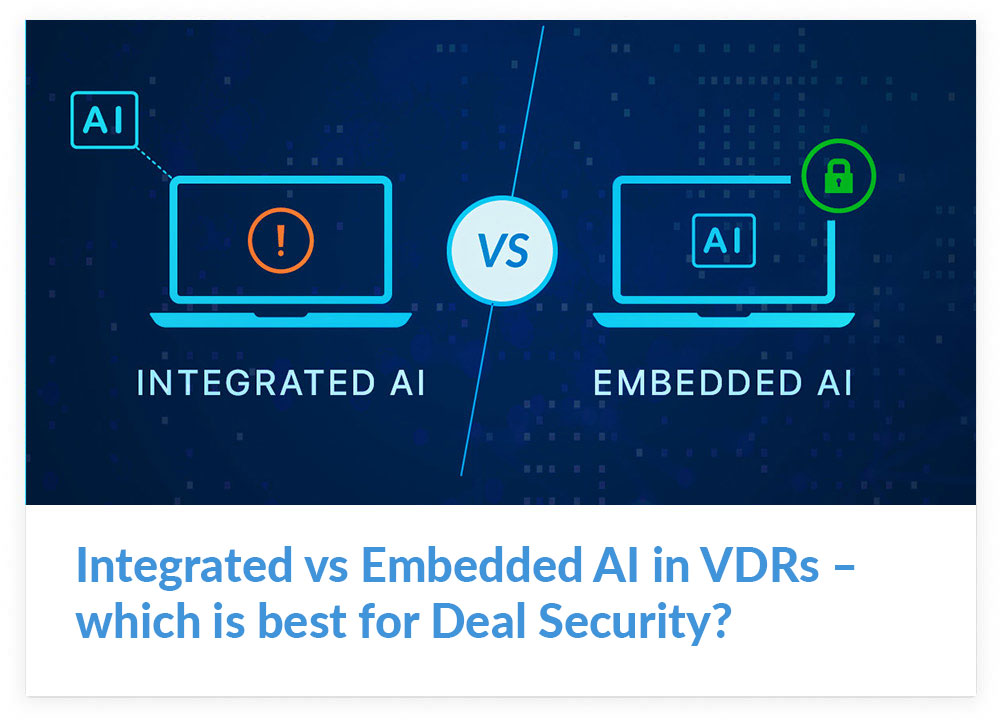
- Embedded AI sits entirely within your VDR platform – processing data, generating insights, and delivering results without ever leaving the environment you’re working in.
- External AI, by contrast, connects your VDR to outside services via its API – sending portions of your data beyond the platform for processing before returning results to you.
The difference has consequences that go well beyond security. It impacts usability as well.
Read our previous blog: Integrated vs Embedded AI in VDRs – which is best for Deal Security?
Granularity – using what you need, when you need it
When a VDR interfaces with an external AI tool via an API, deal teams don’t just get the features relevant to their transaction. The external tool wasn’t built for AI-powered due diligence in a VDR – it was built for a more general use. The limitations of its API, its logic, its feature set, and the granularity of its document intelligence reflect that. In a live deal, that creates noise and gaps: functionality you didn’t ask for, and functionality you need that simply isn’t there, in an environment that wasn’t designed for your workflow.
Embedded AI doesn’t work that way. Because it’s built directly into the VDR, every feature exists for a reason pertinent to the deal workflow – to support the specific demands of a live deal. There’s no redundant functionality, and no need to adapt your workflow to fit the AI tool. Instead, the AI adapts to you.
Interactivity – AI that keeps pace with your deal
In a live due diligence process, with tight closing timelines, speed of response isn’t a nice-to-have, it’s fundamental. When a request is made, the expectation is an answer, not a delay.
Embedded AI is interactive by design. Because it sits inside the secure environment alongside your documents, it can begin processing the moment a request is raised, instantly identifying relevant content, drafting a response, and routing it through the appropriate workflow without ever leaving the platform.
External AI can’t work that way. Before any processing can begin, data has to travel outside the VDR to an external service. The AI can only work with what it’s been sent – which means either document excerpts are continuously pushed outside the secure environment, or someone has to manually select what’s relevant before processing can even begin. Neither is a workable approach at the pace a live deal demands. In a fast-moving process, that’s not just slower, it fundamentally breaks the real-time interactivity that makes AI-powered due diligence valuable in the first place.
An example: AI-driven Q&A
Consider generative AI-driven Q&A in a VDR. A bidder raises a question during the final stages of due diligence. With Imprima’s embedded AI, the moment that question is submitted, the AI begins processing it instantly, searching across the documents inside the VDR, identifying the most relevant paragraphs, and drafting a reference-backed answer, all within the familiar Q&A workflow. The sell-side team reviews it, refines it if needed, and publishes it – without ever leaving the platform or waiting for data to travel to and from an external service.
Now consider how that same process works with interfaced external AI:
- The question is received, but before the AI can begin processing, document excerpts need to be sent outside the VDR to an external service.
- Unlike embedded AI, it has no ability to search interactively across the full document set, and sending the entire contents of a VDR to an external service isn’t feasible. The AI works only with what it’s been given.
The results return to the VDR, but often with less information than was needed – requiring additional manual work to fill in the gaps that well-designed embedded AI would have addressed automatically. In a final closing window, that sequence of steps isn’t just slower – it also leaves the deal team working with less than they need. That’s not a minor inconvenience – it renders it to be a different class of tool entirely.
Embedded AI: purpose-built for due diligence
In M&A, the tools you use during due diligence need to match the demands of the process – not the other way around. Interfaced external AI asks deal teams to adapt to a general-purpose third-party AI integration that wasn’t built for their deal workflow, their pace, or the specific demands of a live deal. Embedded AI is different – purpose-built for due diligence, with every feature of its document intelligence designed to support the pace and complexity of a live transaction.
The result is real-time AI that is responsive, and more precise – not because it’s more “powerful” in a general sense, but because it was built for exactly this context.
At Imprima, that’s the only approach we’ve ever taken. Our AI works entirely within the secure platform – no external processing, no tool switching, and no friction when you can least afford it.
A note on AI assistants like Claude and ChatGPT
You might reasonably ask: if AI assistants like Claude or ChatGPT can connect to a VDR via an agentic AI integration, doesn’t that mean confidential documents are leaving the secure environment, or reintroducing the loss of interactivity we’ve described above?
Not necessarily, on either count. It depends on where the actual processing happens. If the assistant is simply the interface while the searching and reasoning still happen inside the VDR’s own embedded AI, the documents themselves never leave the secure environment – and most of the work that takes time happens internally, not externally. There’s still a conversational round-trip to the assistant itself, but that’s a different thing entirely from sending document content out for processing.
That’s the standard we hold ourselves to, and it’s one we’re building toward directly – we’re developing connectivity that brings AI assistants like Claude and ChatGPT into your Imprima workflow without compromising that principle. More on that soon.
Are you looking for a VDR with fully embedded AI Due Diligence tools? Speak to our sales team